When Angela Merkel gathers six other world leaders in a Bavarian castle for G7 talks, they will face a heavy agenda, with 26 hours to cover everything from climate change and foreign trade to plastic waste and female empowerment.
During the weekend there will be some opera to lighten the load, performed by a star singer flown in for the occasion, as well as spectacular Alpine scenery to help inspire Merkel and her guests as they try to come up with solutions for some of the world’s most pressing problems in their 1,000m mountain retreat.
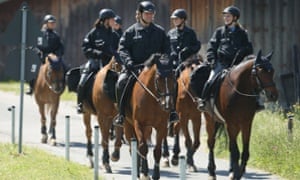
More than 17,000 police dotted throughout the surrounding thick forests, and below in the valley, have the job of protecting the leaders of Germany, France, Britain, Japan, Canada, Italy and the United States from terrorists – and the tens of thousands of protesters who are expected to descend on the nearby town of Garmisch-Partenkirchen.
The German chancellor has staunchly defended the claims that, at an estimated cost of €200 million of mostly taxpayers’ money, Sunday’s summit is too expensive, lacking in rationale when countries like China and India are not involved, and too elitist – a view that has only been enhanced by the choice of the heavily guarded castle Schloss Elmau as a venue, 60 miles south of Munich.
The costs do not include those that the individual leaders will clock up themselves, which, in the case of Barack Obama, who is bringing an entourage of 2,000, will be considerable.
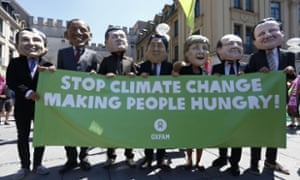
The protesters in the valley complain that it is an exclusive political club of leading industrial countries, taking place at the expense of those countries who are not invited, as well as ordinary citizens.
But speaking ahead of the meeting, Merkel defended the encounter. “For us what’s important are the consequences of globalisation both at home and in foreign lands, because it’s a process we’d like to happen in a just fashion,” she said. “The G7 seizes on central challenges that have a global relevance and are important for many people.”
The seriousness with which she has taken the meeting is reflected in the visits she has made ahead of the event, to Ottawa, Washington, London, Paris, Rome and Tokyo, to make clear to her counterparts early on what her expectations were.
Responsible for preparing the meeting are the high-level diplomats known as sherpas (so-called because they guide the leaders to their destinations), scurrying around in last-minute meetings trying to hammer out deals on every item, in agreements that will then form ‘communiques’. Merkel is only too aware that the results of the gathering have the potential to considerably enhance or sully her legacy forever.
Behind the scenes, the items on the agenda have been thrashed out over the past 18 months or more in intensive discussions, many of which Merkel has attended. Certain topics like climate change are considered obvious ones for the G7 to tackle, along with energy and the global economy. Others, like Ukraine, Greece, Syria, the sanctions against Russia or the Euro crisis, and even the dramatic events unfolding at Fifa, are so pressing they are unavoidable. A third category consists of topics that work their way on to the agenda because they are considered particularly important to the current holder of the G7 presidency, in this case Germany and Merkel.
In 2015 these include the empowerment of women, health issues like Ebola, marine pollution, energy efficiency, and retail and supply chain standards.
“We all recall with horror the events in Bangladesh,” Merkel said this week, in reference to the 2013 collapse of the Rana Plaza factory near Dhaka in what was the deadliest disaster in the history of the garment industry, which claimed more than 1,000 lives.
Another item on the agenda that Merkel has indicated is close to her heart – not just as a politician but also as a former research scientist – is the worldwide growth of antimicrobial resistance and how it is hampering the efficacy of antibiotics. Merkel has said in off-the-record briefings with journalists that the issue is crying out for a political solution on a global level, and is therefore perfect for the G7.
Closely linked to that is the issue of how to tackle the next health epidemic, drawing on the lessons learned from Ebola and Sars and focusing on the growing threat of Middle East respiratory syndrome (Mers). The world’s leading experts on these topics who were hand-picked by Bill Gates at the request of Merkel, were invited for face-to-face talks with her in Berlin in the weeks leading up to the summit. Based on their recommendations, Germany will propose that other G7 leaders sign up to plans to radically reform the World Health Organisationto become effectively able to respond to health crises, including the establishment of an emergency medical reserve corps that could rapidly respond to future epidemics.
“This is a crucial conference for the future of global health,” Jeremy Farrar, professor of tropical medicine at Oxford University and the director of the Wellcome Trust, who was involved in the pre-summit talks with Merkel, told The Guardian. “This is the first time this issue has been at this level of prominence, and it’s largely thanks to Angela Merkel who has really pushed for it and has put her reputation on the line by doing so.”
But where Merkel’s reputation will arguably be most at stake and where the summit’s biggest sticking point is likely to lie, is over climate change and the reduction of carbon dioxide emissions; an area where, despite past pledges, very little progress has been made since 2008. Ideally this G7 will pave the way for a global climate agreement to be reached at the UN climate conference scheduled for December in Paris.
But with the United States unclear on its stance, and Canada and Japan blocking the long-term goal to decarbonise global energy systems, probably no issue is as controversial ahead of the summit than this one.
Germany, with its a reputation as a worldwide pioneer in tackling the Energiewendeor switch to renewables, and having in Merkel a leader who has not only served as environment minister but, due to her background as a physicist, is known to thoroughly understand the issues, could give new dynamism to the debate.
However, warns Greenpeace – just one of many NGOs watching the talks closely – Germany could be in the embarrassing situation of not fulfilling its own target of reducing greenhouse gas by 40 per cent by 2020. Its huge dependence on coal, and the strong opposition to change from both the coal industry and trade unions, makes the prospect of a phase-out difficult, though environmentalists are holding out hope that Merkel might yet rule on a coal phase-out ahead of the summit.
“Merkel has chosen to put this topic high on the agenda of an international meeting, but without making a clear commitment to this domestically, she risks losing her reputation as a climate chancellor,” Martin Kaiser, head of international climate politics at Greenpeace, told The Guardian.
Meanwhile, as the tough negotiating proceeds within the castle walls, the spouses will be provided with their own programme of entertainment. As is tradition, Merkel’s chemistry professor husband, Joachim Sauer, will take on the role of host to the wives of Shinzō Abe of Japan, Stephen Harper of Canada and the European Council president Donald Tusk. He is to lead a sightseeing tour of the region, including the nearby Linderhof palace, of the so-called 18th century ‘Mad King” Ludwig II of Bavaria, and to a lecture on nanotechnology by Munich professor Wolfgang M Heckl.
The spouses will also be invited to a musical evening on Sunday, in Schloss Elmau, when – at the request of Merkel and Sauer, both opera fanatics – the star sopranist Waltraud Meier will perform lieder by Richards Strauss and Wagner.
Overshadowing the event is the absence of Russia. Putin was refused an invite over the annexation of the Crimea.
The scandal surrounding Germany’s intelligence service, the BND, amid claims it spied on EU officials and companies on behalf of the US National Security Agency, has also threatened to sour relations between Merkel and Obama.
Possibly to ease the tension, both leaders are due to meet for bilateral talks ahead of the summit on Sunday morning over beer and pretzels. Though Merkel has explicitly said the NSA row will not be on the agenda. The nearby village of Krün will host the leaders, prefacing their discussions with a performance by a brass oompah band and dancers in lederhosen and dirndls, in what the mayor has promised will be a “beer garden atmosphere”.
After that it will be off up to Elmau, where a landing pad for six helicopters has been built at the back of the hotel, which has variously served as a spa resort for Wehrmacht soldiers and a post-war recuperation site for Holocaust survivors. There, among the 300 staff on duty, will be Michelin-starred chefs on alert round the clock to feed leaders as they negotiate well into the night.
“Considering we only have 24 hours and also need to sleep a little bit in between, it is, I believe, an ambitious agenda,” Merkel told a gathering of foreign journalists this week. “I’m looking forward to some intensive and very friendly discussions.”
Up for discussion: topics at the G7
The G7 club grew out of a meeting between French president, Valéry Giscard d’Estaing and German chancellor, Helmut Schmidt, who first met for a quiet fireside chat outside Paris. Now in its 41st year, the event has evolved beyond recognition. Topics for discussion at this year’s summit, which will cost an estimated €150m to €200m, include the global economy – and such matters as TTIP, the free trade agreement between the United States and Europe, the CETA agreement with Canada, and agreements between the United States and Pacific partners, including Japan) – development issues; climate change (with particular focus on the UN Climate Conference in Paris in December that aims to see an agreement on ensuring global warming does not exceed two degrees); global health, including the fight against antibiotic resistance, neglected tropical diseases, in the light of the recent Ebola epidemic and reform of the WHO; female empowerment in the developing world, particularly professional training; and retail and supply chain standards.
Part of the 26-hour-long gathering will include time spent in so-called “outreach meetings” with guests mainly from Africa, including the presidents of Nigeria, Liberia, Senegal, Ethiopia, Tunisia as well as Iraq. The main topic of conversation will be the fight against terrorism, and thereafter, health and development goals beyond 2015. Invited to these discussions will also be the UN general secretary, the chief of the World Bank, representatives from the World Trade Organisation, the Worldwork organisation, the IMF and the OECD.
Open all references in tabs: [1 – 5]